
Glynn Projected Release Dates
A projected date is a calculation or decision based on facts known at that point. An actual release date records what happened. The two can differ because a court order, unresolved hold, transfer, earned credit, misconduct, or parole decision changes the custody path.
Glynn County jail timing is not computed through the state prison incentive program. GCDC release can follow bond posting, own-recognizance release, dismissal, time served, warrant clearance, transfer, a court order, or completion of a county sentence. The sheriff record and court disposition are the best sources for that event. The daily Population With All Charges Report shows current detainees and booking details, but not a final future release date for every person.
| Status | Date source | Meaning |
|---|---|---|
| Pretrial at GCDC | Court, bond, and hold records | No fixed date may exist |
| County sentence | Court order and sheriff records | Term adjusted by lawful jail credit and orders |
| State prison | GDC and parole board | MRD, TPM, or later release decision |
| Already released | Originating agency record | Actual release or discharge date |
Find Glynn Release Dates
Start with custody type. The Georgia Department of Corrections is not the primary source for someone arrested in Glynn County and released from GCDC without entering state prison. It becomes central after a state sentence or transfer.
- Check the Glynn Detention Center source for current local custody. A person absent from the daily report may be released or transferred, so absence alone is inconclusive.
- For local jail timing, use the booking and case details to contact the jail and the court. Ask for the controlling order, release date, release type, or transfer destination.
- For state prison, open GDC Find an Offender and search by name, description, ID, or case number.
- For parole timing, use the TPM explanation and lookup. Read the month as tentative.
- After an apparent release, verify through the sheriff record, GDC written records, parole data, or the court. The Glynn released inmate search joins those routes.
GDC warns that its online information may be incomplete and directs users to verify through Inmate Records and Information, PO Box 1529, Forsyth, GA 31029. That warning matters when family plans, transport, legal filings, or supervision reporting depend on the date.
Glynn TPM and MRD
Georgia uses two important date concepts for state prisoners. Maximum Release Date, or MRD, is tied to the maximum term as adjusted under applicable rules. Tentative Parole Month, or TPM, is the month in which the parole board expects to complete final review and, if appropriate, set a parole release date.
A TPM is not a final parole decision. The board can postpone or cancel it because of misconduct, new case information, incomplete programs, a failed residence plan, or another case factor. The board may instead set a reconsideration date or decline to set a TPM. For life-sentence cases, the decision is framed as grant or deny rather than the ordinary TPM path.
- MRD
- Maximum Release Date, a sentence-end date subject to lawful adjustments.
- TPM
- Tentative Parole Month, a parole-review target that can change.
- Parole release date
- The later date set when the board grants release.
- Discharge
- The official end of custody or supervision.
Do not combine the fields into one promised date. A person may have both an MRD and TPM because one reflects the maximum term while the other reflects discretionary parole review.
Georgia PIC Release Credits
The GDC Performance Incentive Credit Program, or PIC, rewards eligible state offenders for satisfactory progress in education, vocational or treatment programs, work assignments, and good behavior. Eligible offenders can build up to 12 points and may receive one to 12 months off a TPM or MRD.
The successful GDC PIC source image shows the official program context:
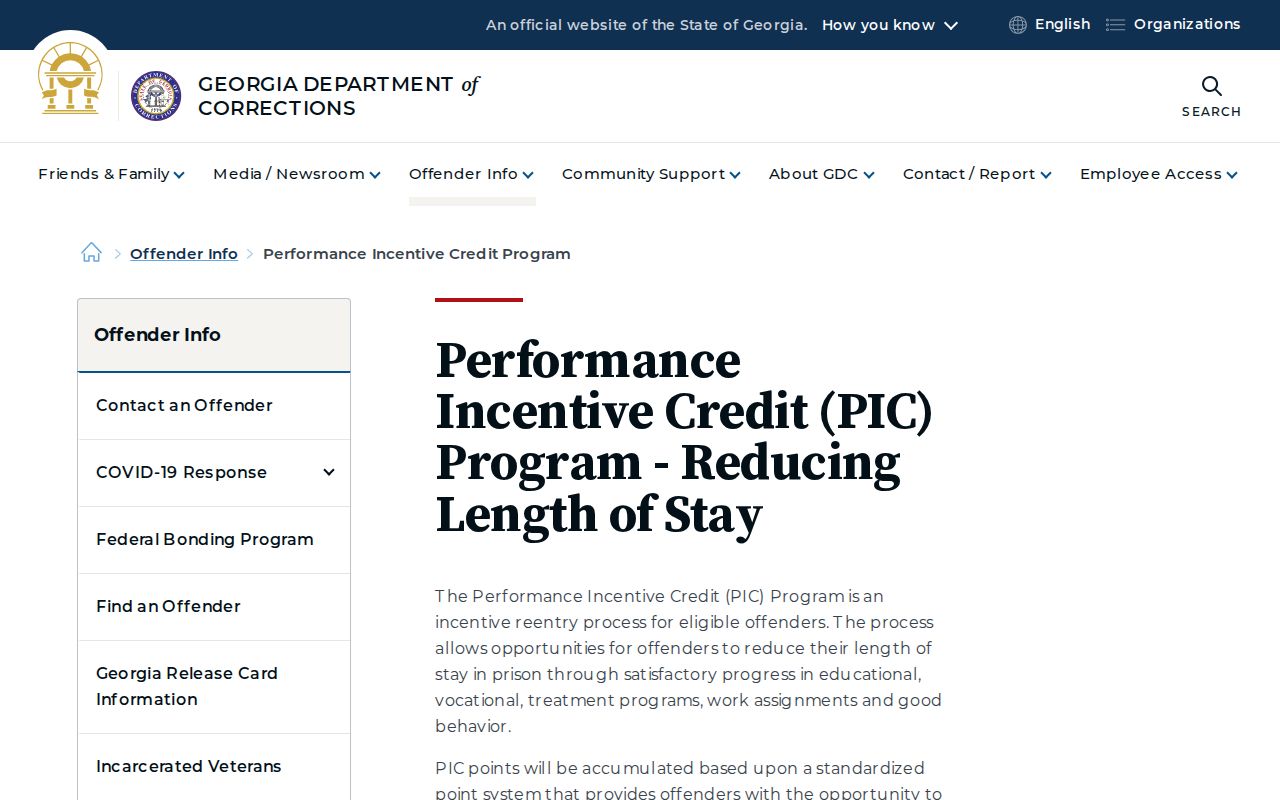
PIC does not apply to every Glynn County inmate. GDC lists exclusions that include probationers, death-sentence offenders, terms of two years or less, non-parole-eligible or mandatory-minimum cases such as specified serious violent offenders, and life sentences with or without parole. A county-jail detainee does not enter PIC merely by being housed at GCDC.
O.C.G.A. 42-5-101 authorizes work incentive credits for qualifying felony prison terms other than life. Credits may recognize institutional achievement, work, and compliance. GDC reports them to the parole board, which considers them in a final parole decision and may use them to advance a tentative date.
Note: An earned credit can change a calculation, but it does not override a mandatory minimum, hold, court order, or final board decision.
Glynn Release Date Changes
A projected date changes when one of the facts used to calculate it changes. Local jail and state prison cases have different triggers. Ask which agency owns the field before seeking an explanation.
| Factor | Possible effect | Confirm with |
|---|---|---|
| Bond posted or court order | Creates or changes a county release path | GCDC and court |
| New or cleared warrant | Adds or removes a hold | Issuing agency and jail |
| Jail credit or amended sentence | Changes sentence completion | Sentencing court |
| PIC earned or denied | May adjust TPM or MRD | GDC and parole board |
| Misconduct | Can affect credit or parole review | GDC and board |
| Program not completed | Can postpone a TPM decision | GDC and board |
| Residence plan fails | Can delay parole release | Parole board and DCS |
| Detainer or agency transfer | Can prevent community release | Holding and receiving agencies |
A detainer is a request or legal basis for another authority to take or continue custody. Thus, “released from Glynn County jail” can mean transferred to GDC, federal authorities, another jail, or ICE. The county release time is not necessarily the time the person returns to the community.
Georgia Parole Eligibility Dates
Eligibility is the point at which the board may consider parole. It is not a right to release. The Georgia parole process says most parole-eligible inmates become statutorily eligible after one-third of the sentence, but few receive parole at initial eligibility.
O.C.G.A. 42-9-45 supplies eligibility rules and exceptions. Captured statute text indicates a misdemeanor inmate may be eligible after six months or one-third of the sentence, whichever is greater, and a felony inmate generally after nine months or one-third, whichever is greater. Serious-violent, repeat-offender, and other laws can change that result.
O.C.G.A. 17-10-6.1 defines serious violent felonies and mandatory-minimum rules. Parole Board guidance also describes offense-date differences for certain life sentences: seven years for pre-1995 crimes, fourteen years following the 1995 change, and thirty years for crimes on or after July 1, 2006. Never apply those figures without checking the conviction and offense date.
Confirm Glynn Release Timing
For GCDC, call 912-554-7590 and use the Sheriff's open-records portal when the online roster cannot answer the date. Request a specific release time, type, court authority, or transfer destination. Superior Court records explain felony orders. State Court records explain misdemeanor and traffic dispositions.
For state prison, verify GDC data and then check the parole board if a TPM is involved. Once the person is on parole, Parolee Search can show begin and end dates, assigned office data, primary offense, and status when available. DCS handles field supervision through its Glynn County Courthouse location.
Register through VINELink Release Check for a reported custody-change alert. An alert can reduce the need to refresh a roster, but it can lag and does not disclose the full court reason. Confirm the event with the origin office.
Choose Georgia Release Date Tools
The Inmate TPM Lookup answers whether the board has set a tentative month for a state prisoner. It does not show that a final release vote has occurred. The Parolee Search serves a later stage and can show parole begin and end dates, office information, primary offense, and status when available. A Glynn County reader should choose between those tools based on whether the person remains in prison or has begun parole.
The board may set a reconsideration date instead of a TPM. On later review, it can set a tentative month, schedule another review, or deny parole for the remainder of the sentence. For a life-sentence case, the decision is grant or deny rather than the standard TPM path. These distinctions prevent a review date from being mistaken for a date when someone will leave custody.
Georgia Release Credit Limits
PIC eligibility has defined limits. GDC excludes probationers, death-sentence offenders, sentences of two years or less, non-parole-eligible offenses, applicable mandatory-minimum cases, and life sentences with or without parole. A program record should therefore be read with the sentence. Participation or good conduct does not prove that a specific credit was awarded, reported, or applied to the displayed date.
O.C.G.A. 42-5-101 permits GDC to create work incentive credits for qualifying felony prison terms other than life. The statute connects credit to institutional achievement, work performance, and behavior compliance, and GDC reports credits to the parole board for consideration. The board still makes the parole decision. Ask GDC which field changed if an MRD or TPM moves after a credit review.
Glynn Release Holds Change Timing
Local cases can change without any GDC calculation. A judge may issue an own-recognizance or bond order, dismiss a charge, credit time served, amend a sentence, or clear a warrant. Another active charge can still prevent release. Because Glynn's population report includes active and inactive charges, a release-like status on one line must be checked against the whole booking and court order.
Federal and immigration holds create a second clock. The Glynn jail report uses federal-hold language, and the Sheriff's Office reports ICE hold activity. The county can record an exit when another agency takes custody, while the person's community release remains unresolved. Use BOP for federal prison custody and ICE's detainee locator for immigration custody.
Georgia Eligibility Is Not Release
The ordinary eligibility language differs by sentence type. Captured Section 42-9-45 material states that misdemeanor parole eligibility can begin after six months or one-third of the sentence, whichever is greater. For a felony, it can begin after nine months or one-third, whichever is greater, subject to serious-violent, repeat-offender, and other exceptions. Eligibility only opens board review; it is not a scheduled discharge.
Most parole-eligible prisoners have a right to consideration, not a right to be released. New information, misconduct, unfinished programs, or a failed residence plan can change the board's action after an earlier projection. A release plan should rely on a confirmed date from the responsible agency rather than an eligibility calculation.
Public Record Search
Sponsored Results